The Basic Principle: Converting Motion to Heat
All braking systems work on the same fundamental principle: they convert the kinetic energy of a moving vehicle into heat through friction. When you press the brake pedal, mechanical force is transmitted through a hydraulic system to friction components at each wheel. Those components press against a rotating surface, generating friction that slows the wheel's rotation. The energy from that slowing motion is released as heat.
Understanding this helps explain several aspects of brake behaviour. Brakes generate a lot of heat — this is why sustained heavy braking on long descents can cause brake fade. It also explains why brake components wear over time: the friction that slows the vehicle gradually wears away the material doing the work.
The Hydraulic System: How Pedal Force Becomes Braking Force
The connection between your foot on the pedal and the brake components at each wheel is hydraulic. Pressing the brake pedal pushes a piston inside the brake master cylinder, which forces brake fluid through lines running to each wheel. Because brake fluid is incompressible, this hydraulic pressure is transmitted almost instantaneously and with force amplification — a relatively small input from your foot generates much greater force at the wheels.
Most modern vehicles also incorporate a brake servo (also called a vacuum booster or power brake unit) between the pedal and the master cylinder. This device uses engine vacuum or, in some hybrid and electric vehicles, an electric vacuum pump to multiply pedal force further, reducing the effort needed to brake effectively.
The Master Cylinder
The master cylinder is the central hydraulic component. It sits in the engine bay, connected directly to the brake pedal via the booster. It contains a reservoir of brake fluid above the cylinders. Most modern vehicles use a dual-circuit master cylinder, which serves two separate brake circuits — typically one for the front axle and one for the rear, or diagonally split circuits (front-right with rear-left, and front-left with rear-right). This dual-circuit design means that if one circuit develops a leak, the other can still provide some braking ability.
Disc Brakes: How They Work
Disc brakes are the dominant brake type on modern passenger vehicles and are fitted to the front axle of almost all cars, and to the rear axle of most newer models.
The Rotor
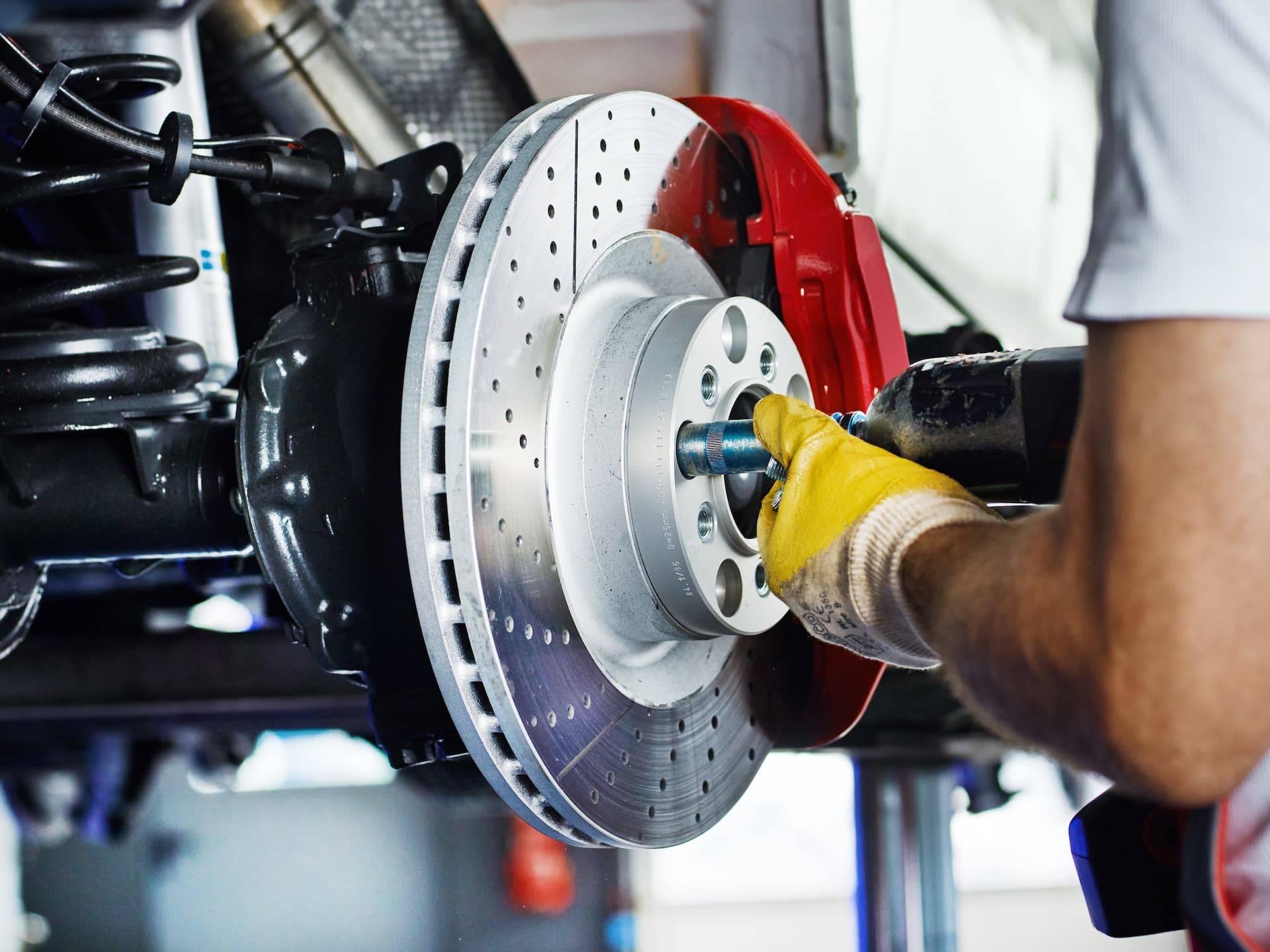
The rotor — also called the disc — is a flat metal disc that rotates with the wheel hub. It's made from cast iron or, in performance applications, composite materials. Rotors vary in design: solid rotors are used in lighter-duty applications, while vented rotors have internal cooling channels between two friction faces that help dissipate heat more effectively. Some rotors are also drilled or slotted to improve wet-weather performance and heat management.
The Caliper
The caliper straddles the rotor and contains one or more hydraulic pistons. When brake pressure is applied, the pistons extend and press the brake pads against both faces of the rotor. Fixed calipers have pistons on both sides of the rotor; floating (sliding) calipers have pistons on the inboard side only and use the caliper body's sliding movement to press both pads against the rotor. Floating calipers are more common on passenger vehicles due to their simplicity and lower cost.
Brake Pads
Brake pads are the wear component of the disc brake system. They consist of friction material bonded to a metal backing plate. The friction material composition varies — organic pads offer quieter operation and gentle initial bite; semi-metallic pads are more durable and better at heat dissipation; ceramic pads produce less dust and maintain consistent performance over a range of temperatures.
Most pads include a wear indicator: a small metal tab positioned so that when the friction material wears down to approximately 2–3mm, the tab contacts the rotor surface and produces a squealing sound. This is a deliberate warning to the driver that replacement is approaching.
Drum Brakes: Still Fitted on Many Vehicles
While disc brakes dominate front axles, drum brakes are still used on the rear axles of many smaller and mid-range passenger vehicles, particularly where a separate drum handbrake mechanism simplifies the parking brake system design.
A drum brake system uses curved brake shoes that press outward against the inner surface of a drum rotating with the wheel. The shoes are lined with friction material and actuated by a wheel cylinder — the hydraulic equivalent of the disc brake caliper. Drum brakes are generally less effective at heat dissipation than disc brakes, which is why they're typically confined to the rear axle where braking loads are lighter.
Drum brake components — shoes, drums, and wheel cylinders — also wear over time and require periodic inspection. Because drum brakes are enclosed, wear is less visible than disc brakes without removing the drum.
Brake Fluid: The Critical but Often Overlooked Component
Brake fluid is the hydraulic medium through which pedal force is transmitted to the brakes. It must remain liquid under pressure and not compress (even slightly), must maintain its properties across a very wide temperature range, and must not corrode the metal and rubber components it contacts.
The key vulnerability of brake fluid is that it is hygroscopic — it absorbs moisture from the air over time, primarily through the rubber hoses in the brake circuit. As water content increases, two things happen: the fluid's boiling point decreases, and the corrosion protection it offers to metal components reduces. A brake fluid with a high water content that reaches its boiling point during sustained braking will partly vaporise, and since vapour compresses (unlike liquid), the pedal can suddenly feel spongy or go to the floor — a phenomenon called vapour lock or brake fade.
Brake fluid should be tested periodically for moisture content and replaced at manufacturer-specified intervals — typically every two years. This is a relatively low-cost service that directly affects braking safety, particularly under demanding conditions.
ABS: Anti-Lock Braking System
ABS is now standard on all new passenger vehicles and has been a legal requirement in the EU since 2004. Understanding what it does helps drivers use it effectively.
During hard braking, wheels can lock — they stop rotating while the vehicle is still moving. A locked wheel slides across the road surface, generating less friction than a rolling wheel in most conditions, and more importantly, a locked wheel cannot steer. ABS prevents wheel lockup by monitoring individual wheel speed sensors and rapidly modulating brake pressure on any wheel that is about to lock — cycling the pressure many times per second, allowing the wheel to continue rotating and the driver to maintain steering control.
The correct technique when ABS activates is to maintain firm brake pressure and steer around the hazard. The pulsing sensation through the pedal during ABS activation is normal and expected — it indicates the system is working.
ABS relies on functional wheel speed sensors, which can be damaged by impacts or corroded over time. An ABS warning light that stays on should be investigated, as it means the system may not be operational.
Other Brake Safety Systems
Modern vehicles often incorporate additional systems that build on the ABS foundation:
- Electronic Brakeforce Distribution (EBD): Automatically adjusts the split of braking force between front and rear axles based on load and deceleration, improving stability under braking.
- Brake Assist (BA): Detects emergency braking situations based on the speed of pedal application and, if full pressure hasn't been applied, automatically increases brake pressure to its maximum. Designed to help drivers who don't naturally apply full braking force in emergencies.
- Electronic Stability Control (ESC): Monitors vehicle yaw and can selectively apply individual wheel brakes to counteract understeer or oversteer and keep the vehicle on its intended path.
These systems all depend on functional wheel speed sensors, ABS hardware, and properly maintained brake hardware and fluid. They're designed to work within the limits of the vehicle's brake system — they can't compensate for severely worn pads or deeply degraded brake fluid.
Maintenance Intervals for Key Brake Components
Different brake components have different maintenance requirements based on how they wear:
- Brake pads: Inspect at every service; replace when below minimum thickness (typically 2–3mm). Interval varies widely with driving style — anything from 40,000 to 80,000 km.
- Brake discs (rotors): Replace when below minimum thickness specification or when surface condition is poor. Usually last through two or three sets of pads under normal use.
- Brake fluid: Test at least every two years; replace when moisture content exceeds safe limits or per manufacturer schedule.
- Drum brake shoes: Inspect periodically; replace when friction material is near minimum thickness.
- Brake hoses: Visual inspection at each service; replace if cracking, swelling, or deterioration is evident — typically every 6–10 years as a precaution regardless of appearance.
Key takeaway: The braking system is a collection of components that work together. Maintaining any single component in isolation isn't enough — pads, rotors, fluid, and calipers all need to be in reasonable condition for the system to work as designed. Regular inspection gives you the information needed to make timely, informed maintenance decisions.