How Modern Vehicle Diagnostics Work
Today's vehicles are equipped with a network of sensors and electronic control units (ECUs) that monitor engine performance, emissions, transmission operation, ABS function, and much more. When a sensor reading falls outside acceptable parameters, the relevant control unit stores a diagnostic trouble code (DTC) and may illuminate a warning light on the dashboard.
These codes don't identify the exact fault in isolation — they indicate which system or circuit has reported a problem. Interpreting them accurately requires reading the code, understanding what circuit or parameter it references, and then following a logical diagnostic process to find the actual cause. Clearing a code without investigating the underlying issue will usually result in the light returning.
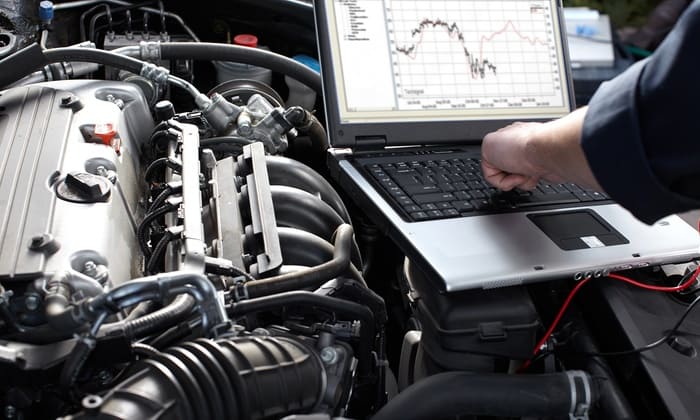
Our diagnostic equipment connects to your vehicle's OBD-II port (or the manufacturer-specific connector on older vehicles) and communicates directly with the control units. We can read stored fault codes, view live sensor data, and — on many vehicles — access manufacturer-specific functions that go beyond generic OBD-II scanning.
What a Diagnostic Session Covers
When you bring a vehicle in for diagnostics, the process starts with a conversation. We ask about when warning lights appeared, any changes in how the car drives, and any relevant history. This context often points toward the area worth investigating first.
Fault Code Reading
We scan all accessible control units and retrieve any stored or pending fault codes. Some faults are stored as permanent codes; others are intermittent and may appear only when specific conditions are met. We document what we find and use the manufacturer's documentation to understand what each code indicates.
Live Data Analysis
Beyond codes, our equipment can display real-time sensor readings. This is particularly useful for diagnosing performance issues — such as poor fuel economy, rough idling, or hesitation under load — that may not have triggered a specific fault code. We can monitor parameters like air-fuel ratio, throttle position, coolant temperature, oxygen sensor output, and injection timing simultaneously, looking for values that drift outside expected ranges.
System-Specific Tests
For some systems, we can run activation tests — commanding components like fuel injectors, EGR valves, or cooling fans to operate and observing their response. This helps confirm whether a component is functioning correctly or whether the problem lies elsewhere in the circuit.
Common Warning Lights and What They Mean
Dashboard warning lights are designed to alert you, not necessarily to cause alarm. Understanding the general categories helps you respond appropriately:
- Engine management light (amber): Indicates an issue detected by the engine management system — could range from a sensor fault to an emissions system concern. The vehicle is usually still driveable but should be scanned promptly.
- Engine management light (red) or temperature warning: These are more urgent indicators. If an engine temperature warning appears, pulling over and letting the engine cool down is advisable before driving further.
- ABS warning light: The standard braking system continues to function when the ABS light is on, but the anti-lock function is disabled. This should be investigated before conditions arise where ABS would be needed.
- Battery / charging warning: Indicates the charging system is not maintaining correct voltage. This can lead to the vehicle cutting out if not addressed.
- Oil pressure warning: Requires immediate attention. Low oil pressure can cause rapid engine damage. Stop safely and check oil level before driving further.
After the Diagnostic — Our Process
Once we've completed the diagnostic, we put together a clear report of what we found. If the fault has a straightforward cause and a defined repair, we'll explain it and provide a quote. If the diagnostic points toward a more involved investigation — such as an intermittent electrical fault that requires further testing — we'll explain what that involves before any additional work proceeds.
We don't start repair work based on a diagnostic alone without your approval. The diagnostic is an information-gathering step, not a commitment to any particular repair.
For some faults, the diagnostic may reveal that no repair is immediately necessary — perhaps a code was triggered by a one-time event and hasn't recurred. In that case, we'll explain the situation and discuss whether monitoring the vehicle makes sense.
Useful to know: Many generic fault codes can have multiple possible causes. A thorough diagnosis looks at the full picture — not just the code number. Replacing a part based on a code alone, without proper diagnosis, sometimes resolves the issue and sometimes doesn't. Proper diagnosis takes a little more time but often saves money overall.